What we built
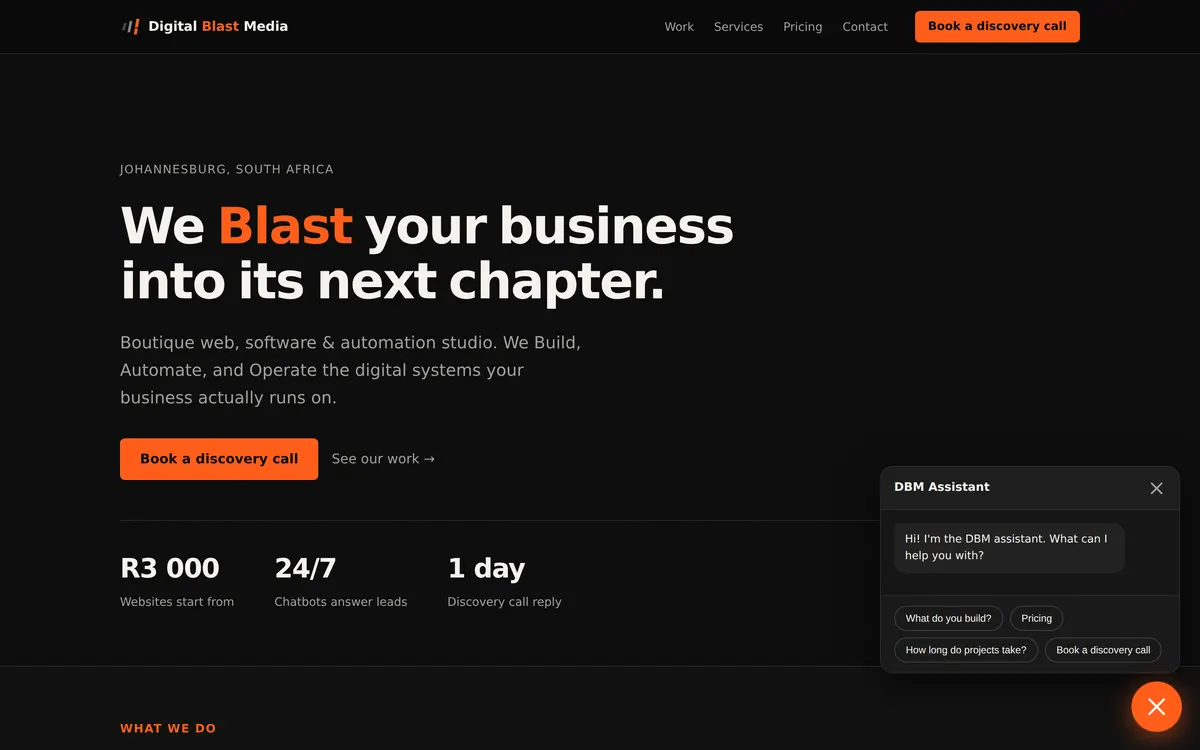
The chatbot on this site is a scripted decision tree. A floating button sits in the corner of every page. Click it and the assistant opens with a handful of choices — services, pricing, timelines, book a call. Each answer is pre-written; each choice leads to the next branch. Every dead end points to the contact form.
There are no API calls, no language model, no monthly bill. The entire thing runs in the visitor's browser from a small JavaScript file that ships with the site.
We chose this approach deliberately. For a boutique studio whose question set is small and well-defined — what do you build, how much does it cost, how long does it take — a scripted assistant answers correctly every time, with nothing to maintain and no risk of inventing an answer it doesn't know.
The four approaches — and when to use each one
Rule-based isn't the right answer for every business. Here are the four options we build, in roughly ascending order of cost and complexity.
Rule-based decision tree (what we used here). Scripted paths, quick-reply buttons, pre-written answers. Running cost: zero. Best for a contained question set where you know what visitors ask and want full control over every reply. Limitation: anything outside the script falls back to 'talk to us' — it cannot improvise.
AI-powered with a language model. The visitor types freely; a model (Claude Haiku or GPT-4o mini) reads a system prompt containing your knowledge base and responds in plain language. Running cost: typically R20–R150 a month for a small business at current LLM pricing. Best for varied product catalogues, technical services with many edge cases, or anywhere free-text input converts better than a button menu. Worth knowing: language models can state things confidently that aren't quite right. A tight system prompt reduces this, but never to zero.
WhatsApp chatbot. The same logic — rule-based or AI — delivered inside WhatsApp rather than a website panel. Running cost: free for the first 1 000 conversations per month via the Meta Cloud API, then a few rand per conversation after that. Best for SA businesses where customers already expect WhatsApp contact. Requires a Meta Business Account and a dedicated number, which adds roughly a day of setup.
Hybrid — scripted triage, human close. The chatbot handles the known questions. A qualified lead gets a WhatsApp link or a book-a-call button and lands with a person. No language model required. Running cost: zero or Meta conversation rates depending on the routing. Best for high-ticket services where the bot qualifies and a human closes.
What actually makes a chatbot useful
Most chatbots fail not because of the technology but because the goal is unclear. A bot that tries to answer every possible question is less useful than one that does one thing well.
The question to answer before building is: what single action do you want the chatbot to move people toward? For us it is a discovery call. Every branch in the script ends at the contact form. A product business might route to a quote request. A clinic might route to a booking link. That clarity determines the script, which determines the right approach.
Knowledge maintenance is underestimated. For a rule-based bot, updating an answer means editing a plain file and redeploying — under ten minutes. For an AI-powered bot it means updating the system prompt. Either way, someone needs to own it when prices change or a service is added. We include a plain-English editing guide with every chatbot we build.
What we would build for you
For most small businesses starting with chatbots, we recommend rule-based first. It is fast to build, costs nothing to run, and you can read every answer before it goes live. If visitor questions outgrow the script — if you find yourself adding dozens of branches or receiving enquiries the bot cannot handle — we layer in a language model at that point.
WhatsApp is worth adding early if your audience is mobile-first and already contacts suppliers there. The setup cost is low; the reach in the SA market is high.
If you run a high-ticket service where leads need qualifying before a human gets involved, the hybrid approach often outperforms a full AI implementation. The conversion point is still a person — the bot just makes sure the right people reach them.
We build all four. Book a discovery call and we will tell you which one fits.